
Curious about homeschooling? Learn how it works, its benefits and challenges, costs, and how to decide if learning at home is right for your family.
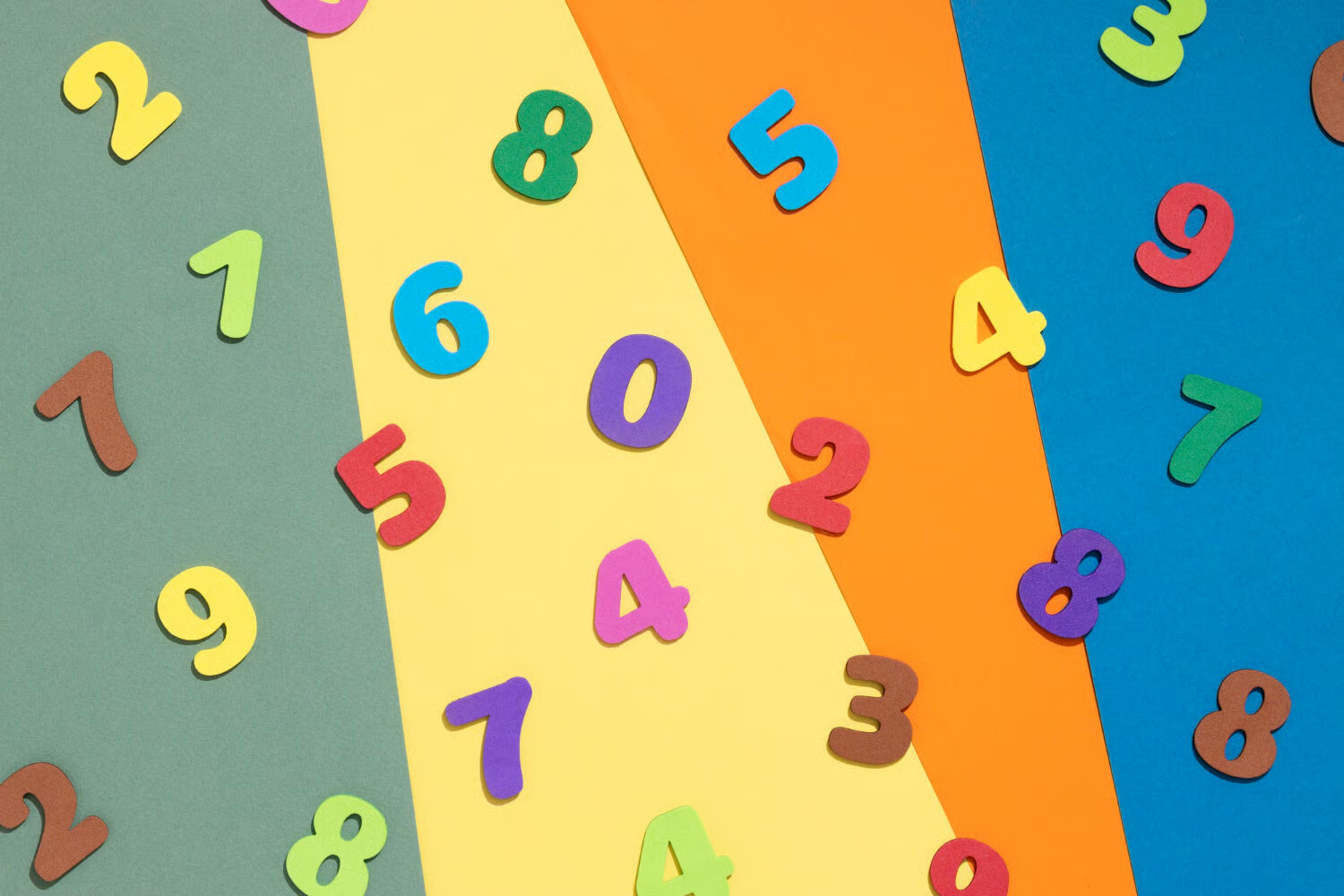
Many children can quickly recite math facts like 5 + 3 = 8 during classroom activities or flashcard practice. But when asked to explain why the answer works, show it using objects, or solve a similar problem in a different way, some learners may suddenly pause and think a little longer.
Imagine two children solving the same addition problem during math time.
One immediately repeats the answer from memory after practicing it the day before. The other uses blocks, draws circles, or counts on fingers to understand how the numbers combine to make a total. Both learners arrive at the correct answer, but their thinking processes look very different.
This reveals an important part of early math learning that goes beyond memorization. Remembering equations can help children respond quickly, but understanding how numbers connect encourages stronger reasoning and more flexible mathematical thinking skills.
This deeper understanding is known as number sense. But what exactly does number sense mean in early math learning?
Number sense is the ability to understand numbers beyond memorized equations. It helps children notice number patterns, compare quantities, and explore different ways to solve problems. Instead of viewing math as something to simply repeat, learners begin to engage with numbers in a more curious way.
Children use number sense when they:
Number sense is not only useful during math lessons or worksheets. Children use these skills in everyday situations too, like sharing slices of pizza, counting money, estimating how many toys can fit in a box, or comparing prices at the store.
These small real-life moments help learners see that numbers are not just something found in textbooks, but tools they can use to understand and navigate the world around them.
Strong number sense can shape the way children experience math as they grow. Let’s explore why this skill is so important during the early stages of learning.
Learners with strong number sense may adjust more easily because they already understand that numbers can be grouped, compared, and represented in different ways.
For example, a child may recognize that 40 means 4 groups of ten instead of viewing it as two separate digits. Similar thinking can also support future fraction lessons, such as understanding why one-half is larger than one-fourth.
A child may lose track while counting, realize an answer does not look right, or suddenly spot an easier way to solve the problem. Instead of giving up, learners with strong number sense begin adjusting their strategy and trying again.
For example, a child solving 15 + 9 may decide to turn the problem into 15 + 10 first, then subtract 1 afterward because the numbers feel easier to work with that way.
Rather than focusing only on remembering the “right” answer, children begin learning how to think through problems step by step. Learners feel more comfortable trying different approaches and adjusting when needed.
Children are more willing to engage in math activities when they feel they can work through problems in their own way. Number sense can help reduce the fear of making mistakes while learning new concepts.
Familiarity with number relationships and different ways to approach problems can help children feel more comfortable participating, asking questions, and trying unfamiliar problems without becoming discouraged immediately.
Some children feel stuck when a math problem looks different from what they practiced before. Number sense helps learners move beyond rigid methods by encouraging them to adjust numbers and explore easier strategies. For example, a child solving 49 + 2 may instead quickly think of it as 50 + 1.
During homework, children who understand number relationships are often more willing to attempt unfamiliar problems instead of immediately saying, “I don’t know.” Even when the question looks different from classroom examples, learners can use familiar strategies to help themselves work through the problem.
At first, number sense and memorization can seem similar because both involve working with numbers and math facts. However, the learning experience behind them looks very different.
Memorization focuses on remembering answers through repetition. A child may quickly recall that 7 + 5 = 12 because they practiced it several times before. This can help with speed during classroom practice, but learners may feel stuck when the problem appears in a different form or requires explanation.
Number sense focuses more on understanding how numbers work together. Instead of relying only on memory, children begin recognizing patterns, relationships between values, and strategies that help them solve problems in flexible ways. For example, a learner may solve 7 + 5 by thinking of 7 + 3 = 10, then adding 2 more.
Both memorization and number understanding can support math learning, but number sense helps children build reasoning skills they can continue using as lessons become more advanced.
Memorizing math facts can help children answer quickly, but relying only on memorization may make problem-solving more difficult when math activities become unfamiliar. Here are a few common signs to watch for:
Number sense grows through everyday experiences that give children opportunities to explore numbers, notice patterns, and solve problems in different ways. Small math moments during play, routines, and conversations can help strengthen understanding over time.
Math practice does not always need worksheets or flashcards. Children can build number sense while counting apples at the grocery store, comparing snack portions, estimating how many blocks are in a container, or noticing which object is taller or shorter during play.
Children benefit from talking about how they solved a problem instead of only giving the answer. Questions like “How did you figure that out?” or “Can you think of another way?” encourage learners to reflect and explore different strategies.
Helping children notice how numbers connect can strengthen math understanding. Activities involving doubles, number pairs that make 10, grouping objects, or comparing quantities can help learners recognize patterns and relationships more naturally.
Simple activities can make number learning feel more interactive and enjoyable. Dice games, card games, counting challenges, puzzles, and board games encourage children to practice number recognition, estimation, and problem-solving without making math feel stressful.
Not every child approaches math the same way, and that is okay. Some learners may draw pictures, use counters, count on fingers, or solve problems mentally. Exploring different strategies helps them see that there is more than one way to arrive at a solution.
While memorizing math facts can support learning, children benefit most when they understand the reasoning behind the numbers. This is what number sense is all about.
For parents, it can help to remember that meaningful math learning takes time to build. Children do not need to solve every problem perfectly or immediately to make progress. Encouraging children to stay curious and work through challenges can help math feel less stressful and more manageable as learning continues.
Curious about homeschooling? Learn how it works, its benefits and challenges, costs, and how to decide if learning at home is right for your family.
Help kids understand verbs with simple explanations and fun examples they’ll remember.
Want to help your child enjoy reading more? Try these easy ways to make story time more interactive, creative, and lovable.
Help kids master capitalization with the M.I.N.T.S. rule, and other essential capitalization rules.
Help your child master nouns with easy explanations of common, proper, concrete, abstract, and other types of nouns, plus everyday examples.