

Curious about homeschooling? Learn how it works, its benefits and challenges, costs, and how to decide if learning at home is right for your family.
Capitalization is the use of capital letters in specific places when we write. It helps readers understand sentences and recognize important words, such as names, places, and the beginning of a new sentence.
Learning when to use capital letters can be tricky for kids, especially as they begin writing longer and more detailed sentences. The M.I.N.T.S. rule is a helpful way to remember some of the most common capitalization rules, but it does not cover every situation children may come across in school.
This guide offers simple explanations and examples to help parents, caregivers, and teachers make capitalization easier for children to learn.
Teaching capitalization can be easier when children have a simple rule to remember. The M.I.N.T.S. rule groups five common capitalization rules into one easy memory tool:
These five rules cover many of the capitalization mistakes children make in everyday writing. They are a good starting point before introducing more advanced rules.
The names of months and days of the week always begin with a capital letter. This includes every month, from January to December, and every day, from Monday to Sunday.
Examples:
A simple way to remember this rule is: Names of months and days get capital letters.
Seasons are different. Words such as spring, summer, fall, and winter are usually lowercase.
The word I is always capitalized when it is used to talk about yourself. It does not matter where it appears in a sentence.
Examples:
One common mistake is writing i instead of I. Remind children that the pronoun I is always uppercase.
Names are another important reason to use capital letters. Specific names of people, places, and other proper nouns begin with capital letters.
Compare these examples:
Examples:
The easiest rule for children to remember is: If it is the special name of someone or something, start it with a capital letter.
The word title can mean more than a person’s job or position. Children also see titles in the names of books, movies, TV shows, songs, and other works. Brand names are another type of name that uses capital letters.
When a title is used before a person’s name, it begins with a capital letter.
Examples:
When the title is used by itself, it is usually lowercase.
Titles of Books and Movies
The important words in the titles of books, movies, TV shows, and other major works are usually capitalized. Short words such as a, an, the, and, in, and of may stay lowercase when they are not the first word.
Examples:
The first word of a title is always capitalized, even if it is a short word such as The or A.
Example:
Brand Names
Brand names are also capitalized because they are the specific names of companies or products.
Examples:
A simple way to explain this to children is: Specific titles and brand names use capital letters because they identify something special or specific.
One helpful reminder is that not every word in a book or movie title needs to be capitalized. The exact capitalization style can vary depending on the title and the style guide being used, so children should focus first on capitalizing the important words and the first word of the title.
The first word of every sentence begins with a capital letter. This rule applies whether the sentence is a statement, question, command, or exclamation.
Examples:
Children should also remember to use a capital letter when a new sentence begins after a period, question mark, or exclamation mark.
Examples:
A simple reminder for children is: New sentence, new capital letter.
School subjects can be confusing because some are written with lowercase letters while others need a capital letter. The key is to look at what the word names.
General school subjects stay lowercase
Names of general school subjects are usually written in lowercase when they are used as regular subjects.
Examples:
Simply being the name of a school subject does not mean the word needs a capital letter.
Language names are capitalized
Languages are different. Names of languages are proper nouns, so they always begin with a capital letter.
Examples:
Compare these two sentences:
Science is a general school subject, so it stays lowercase. English is the name of a language, so it needs a capital letter.
Note: Official course names can be a little different. If a subject is part of a specific course title, capitalization may be used:
There can be some confusion about capitalization and punctuation because the two work together, but they do not follow exactly the same rules.
Children may learn that a period, question mark, or exclamation mark ends a sentence and then assume that every punctuation mark means the next word should be capitalized. That is not true.
The key is to look at what the punctuation mark is doing. Some punctuation marks end a sentence, while others simply connect or organize ideas within the same sentence.
A period usually marks the end of a complete sentence. When a new sentence follows, its first word begins with a capital letter.
A period can also appear in abbreviations, where it does not mean that a new sentence has started.
The word after the abbreviation does not automatically need a capital letter.
A question mark is used at the end of a direct question. If another sentence follows, that new sentence begins with a capital letter.
An exclamation mark can show excitement, surprise, or a strong feeling. When it ends one sentence and another sentence follows, the next sentence begins with a capital letter.
A colon (:) often appears before a list, an explanation, or additional information. One point that can cause confusion is whether the word after a colon needs a capital letter. The answer depends on what comes after the colon.
When a colon introduces a simple list, the first item is usually lowercase unless it is a proper noun.
However, if an item in the list is a proper noun, it keeps its capital letter.
A semicolon connects closely related ideas. It is stronger than a comma but does not work like a period.
Because the two parts remain connected in one sentence, the word after a semicolon is usually lowercase.
Notice that it and she are lowercase.
A semicolon can also separate items in a complicated list, but it does not automatically require a capital letter.
A comma separates parts of a sentence, but it does not end the sentence. The word after a comma is therefore usually lowercase, unless another capitalization rule applies.
In the last example, Liam is capitalized because it is a name, not because it follows a comma.
Learning capitalization rules is easier when kids have a chance to spot, fix, and practice them in real sentences. To help reinforce the rules from this guide, we created a three-page Capitalization Worksheet with fun activities.
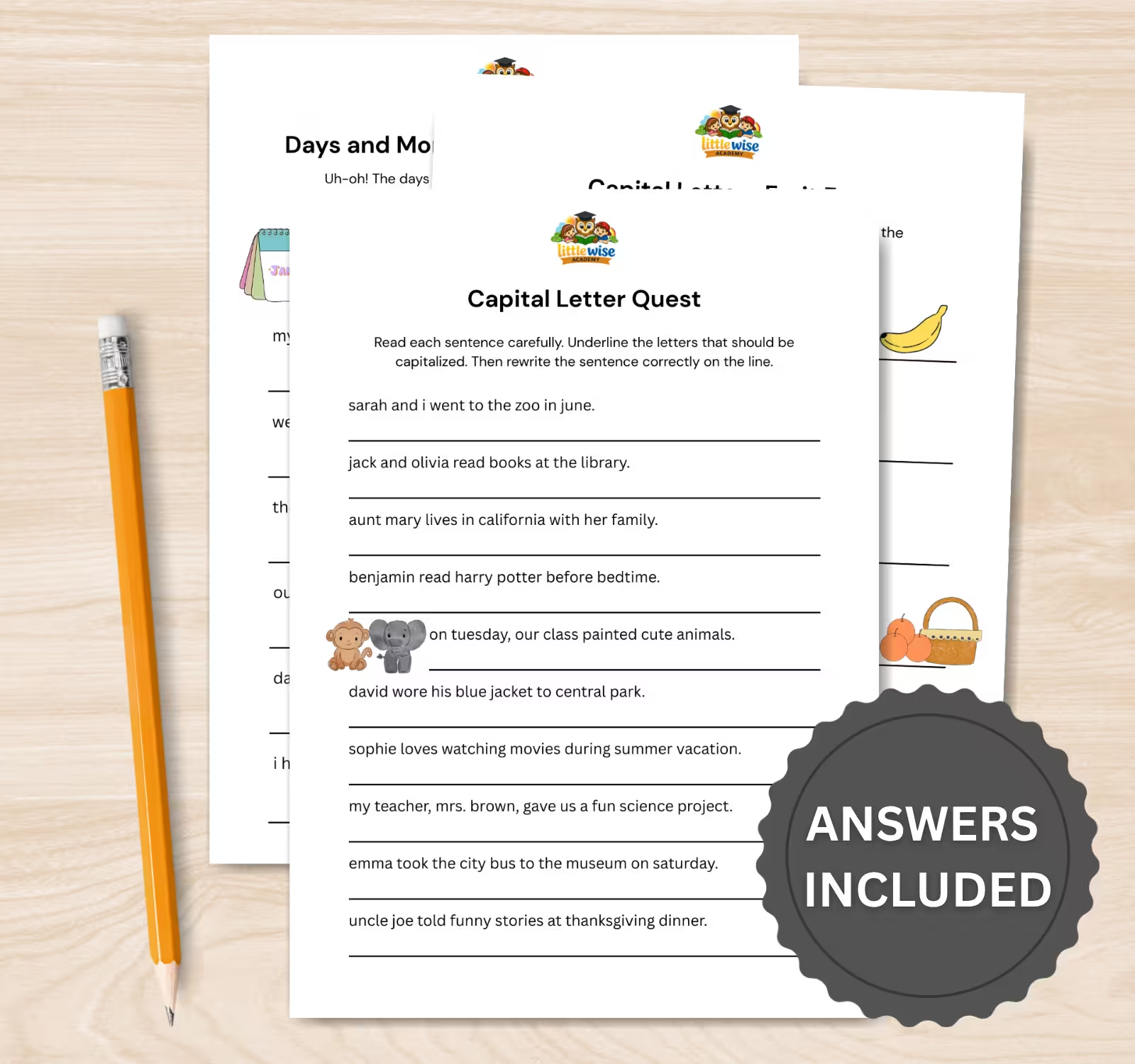
Page 1: Capital Letter Quest
Capital Letter Quest asks children to find words that need capital letters. They will underline the letters that should be capitalized and then rewrite each sentence correctly.
This activity helps children practice identifying capitalization mistakes instead of simply memorizing rules.
Page 2: Capital Letters Fruit Fun
Capital Letters Fruit Fun combines capitalization practice with colorful fruit-themed scenes. Children will read sentences connected to the pictures, find the capitalization mistakes, and rewrite the sentences correctly.
The activity gives them another opportunity to practice names, sentence beginnings, and other common capitalization rules in a fun setting.
Page 3: Days and Months Letter Capitalization
The final page focuses specifically on days of the week and months of the year. Children will read seven sentences and identify the days or months that need capital letters.
Capitalization may seem like a small part of writing, but using capital letters correctly helps children write clear and polished sentences.
The M.I.N.T.S. rule provides a simple starting point, while rules for school subjects and punctuation help children apply capitalization in more situations. Remember that regular practice can help these rules become a natural part of everyday writing.
Curious about homeschooling? Learn how it works, its benefits and challenges, costs, and how to decide if learning at home is right for your family.
Help kids understand verbs with simple explanations and fun examples they’ll remember.

Want to help your child enjoy reading more? Try these easy ways to make story time more interactive, creative, and lovable.
Help your child master nouns with easy explanations of common, proper, concrete, abstract, and other types of nouns, plus everyday examples.

Learn how solids, liquids, and gases are different with simple explanations made for kids. This guide also includes a quick and fun experiment.