
Curious about homeschooling? Learn how it works, its benefits and challenges, costs, and how to decide if learning at home is right for your family.
We’re surrounded by matter. The water your child drinks, the air they breathe, and the chair they sit on are all made of matter. We use and interact with matter every day, even when we may not think about it.
If you’re teaching your child or student about matter soon, this guide will help you explain the topic in a simple way. It covers the three states of matter with familiar examples, fun activities, and a quick experiment that will enhance their learning experience.
Matter is anything that has mass and takes up space. In simple words, if something has a size and can be measured by how much it weighs, it is matter. The water in a cup, the pencil on a desk, and even the air inside a balloon are all examples of matter.
The idea of matter has been studied for thousands of years. There is not one person who “discovered” matter because people have always interacted with it.
However, Democritus, an ancient Greek philosopher who lived around 460–370 BCE, was one of the first to suggest that all matter is made of tiny particles that cannot be divided into smaller pieces.
He called these particles “atomos,” meaning “uncuttable.” Scientists later learned much more about atoms and how matter is made.
Matter can look and behave in different ways. The three states you’ll want kids to know first are solid, liquid, and gas. Each state has unique properties that affect its shape, volume, and how its tiny particles are arranged and move.
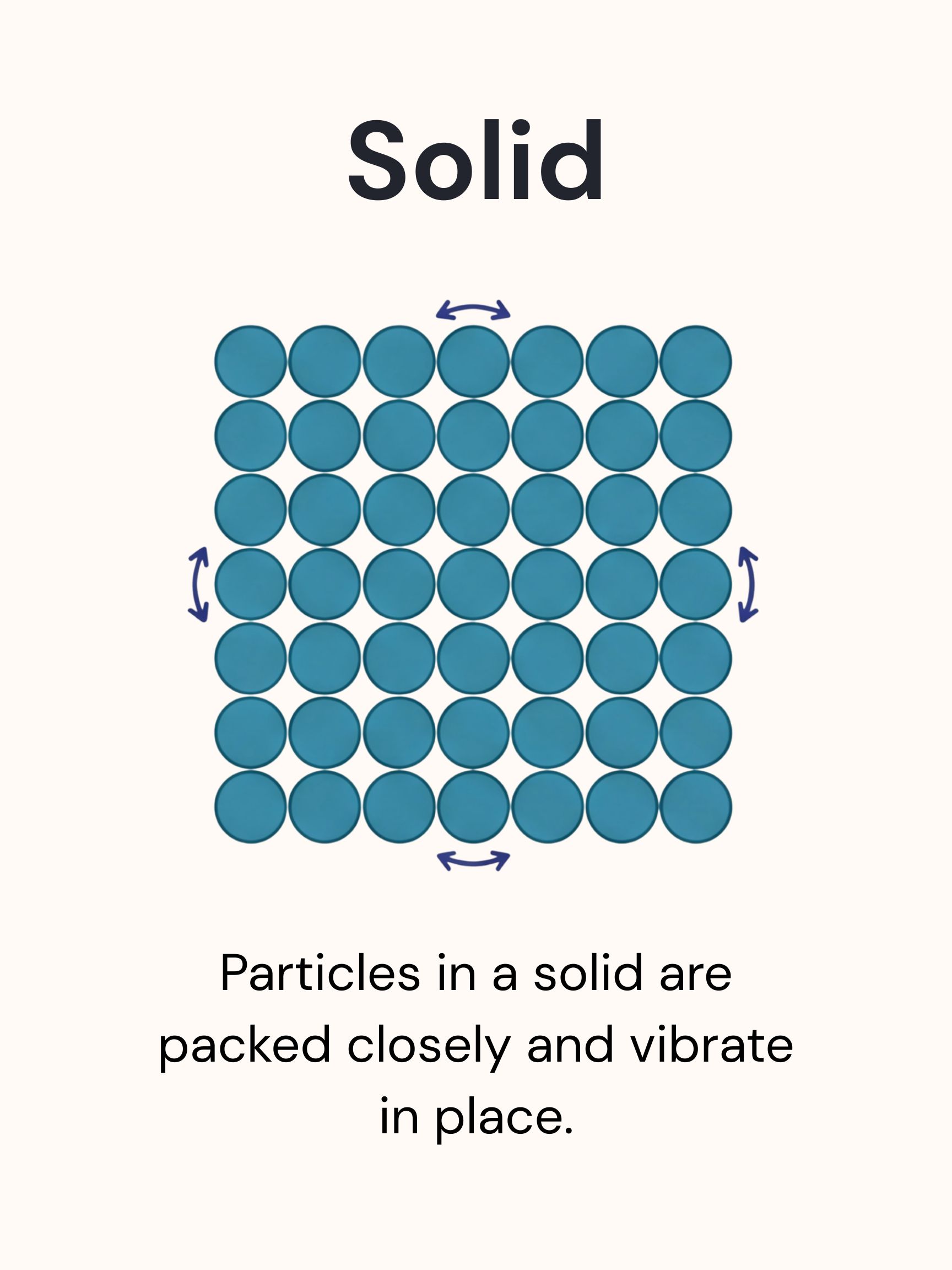
A solid is matter that has its own shape and takes up a certain amount of space. When you place a solid somewhere, it usually keeps its shape unless you bend, break, or change it.
Examples in everyday life:
The particles in a solid are packed closely together. They stay in a fixed arrangement and mainly vibrate in place. Because the particles do not move freely from place to place, solids keep their shape.
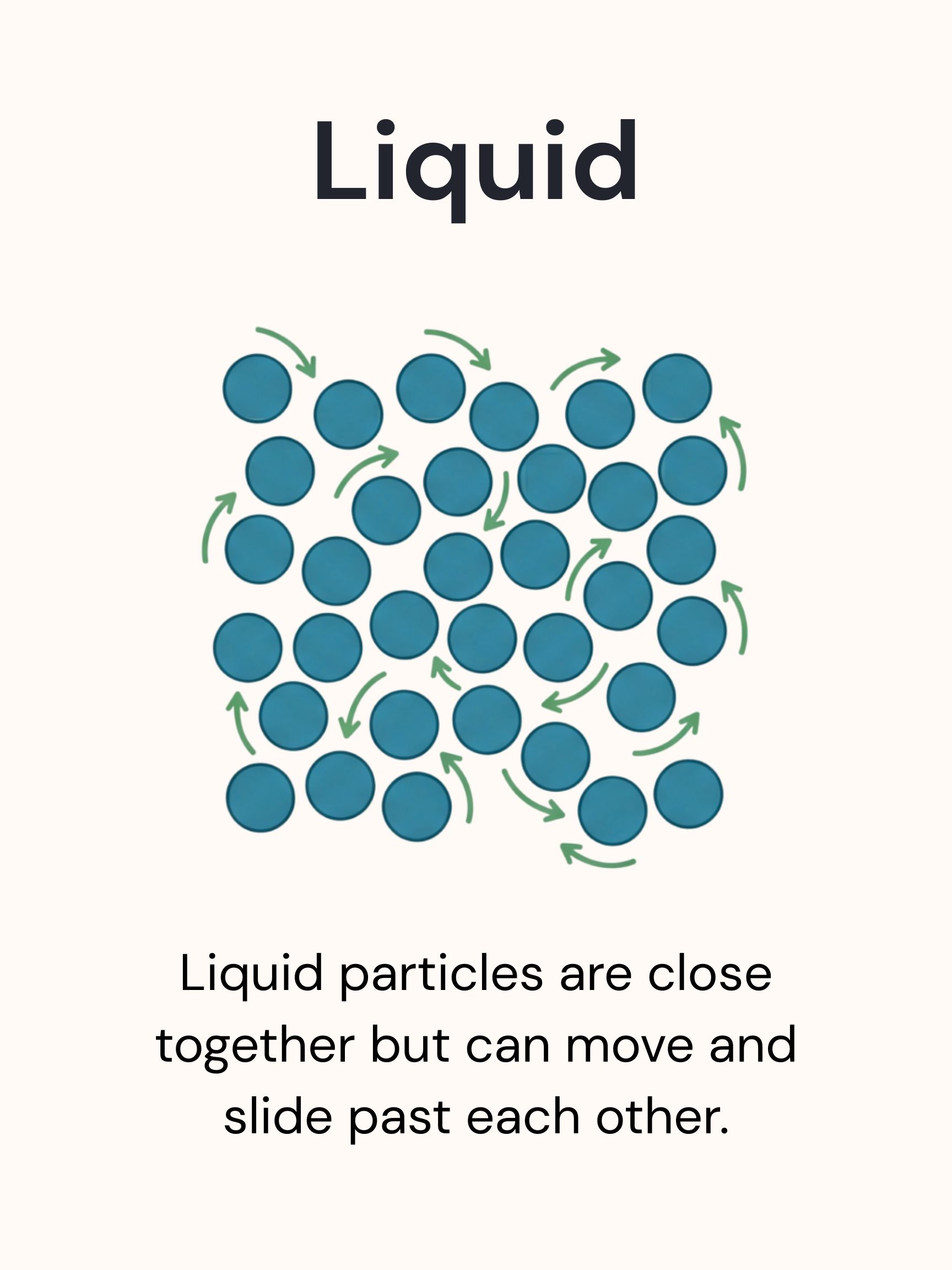
A liquid is matter that has a definite amount of space, but it does not have its own shape. Instead, it takes the shape of the container it is poured into.
Examples in everyday life:
The particles in a liquid are close together, but they are not locked into one position. They can move and slide past one another, which allows a liquid to flow and change shape.
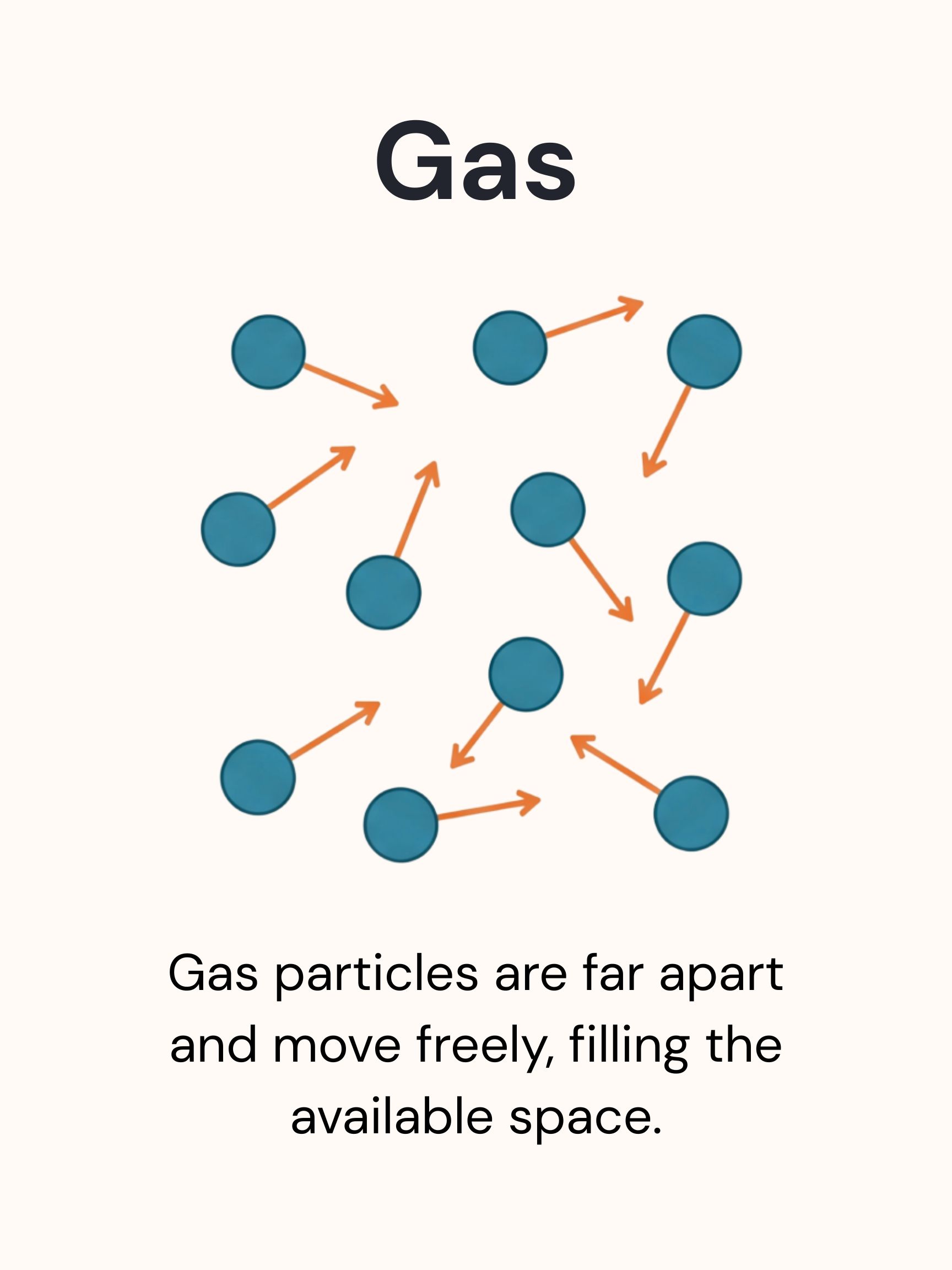
A gas is matter that does not have a fixed shape or a fixed volume. It can spread out and fill the space available to it.
Examples in everyday life:
The particles in a gas are farther apart than those in solids and liquids. They move freely in different directions and spread throughout the available space. This is why gases can expand and fill a container.
Once kids understand what solids, liquids, and gases are, the next step is helping them remember the differences. One simple trick is to connect each state to the first letter of its name. This gives students a quick memory clue they can use when answering questions.
Think of the S in solid as “stays.” A solid usually stays the same shape when you move it from one place to another. For example, if you move a pencil from a desk to a backpack, the pencil is still a pencil with the same shape. The same is true for a book, toy, or spoon.
You can remind kids: S = Solid = Stays the same shape.
For liquid, think of L = Looks like its container. A liquid does not have a shape of its own. Instead, it takes the shape of whatever container holds it. Pour water into a glass, and it looks like the glass. Pour the same water into a bowl, and it spreads out to look like the bowl.
You can remind kids: L = Liquid = Looks like its container.
For gas, think of G = Goes everywhere in the container. Gas particles can move freely and spread out, so a gas fills the space available to it. Air inside a balloon, for example, spreads throughout the balloon instead of staying in one small spot.
You can remind kids: G = Gas = Goes everywhere in the container.
Here’s a simple rhyme to remember: “Solid stays, liquid flows, gas spreads wherever it goes.”
You can even turn the rhyme into a quick movement activity! Have students stand still like a solid, move their hands slowly from side to side like a liquid, and spread their arms out like a gas. It’s a fun way to review their lesson.
Matter does not always stay in the same state. When matter gains or loses energy, its particles can move differently, causing it to change from a solid to a liquid, a liquid to a gas, or back again.
These changes happen all around us, such as when ice melts on a warm day or water droplets form on a cold glass. Let’s take a closer look at four common changes of state: melting, freezing, evaporation, and condensation.
Melting happens when a solid gains enough heat energy to become a liquid. As the solid warms up, its particles gain energy and move more freely.
A simple example is an ice cube. When you leave an ice cube on the counter, it absorbs heat from its surroundings. Its particles move more, and the solid ice changes into liquid water.
Example: Ice → Water
Freezing is the opposite of melting. It happens when a liquid loses heat energy and becomes a solid. As the liquid cools, its particles slow down and become more organized.
Think about water placed in a freezer. As it loses heat, the water eventually turns into solid ice.
Example: Water → Ice
Evaporation happens when a liquid gains enough energy for some of its particles to escape into the air as a gas. This can happen even when a liquid is not boiling.
For example, a puddle of water may slowly disappear after a sunny day. The water particles at the surface gain energy and move into the air as water vapor.
Example: Liquid water → Water vapor
Condensation happens when a gas loses heat energy and changes into a liquid. As the gas cools, its particles slow down and move closer together.
You may have seen this happen on a cold glass of water. Water vapor in the air cools when it touches the cold surface, forming tiny drops of liquid water on the outside of the glass.
Example: Water vapor → Liquid water
You do not need a science lab to show kids how matter can change states. This activity is especially useful for parents, homeschoolers, teachers, and tutors because kids can watch the change happen right in front of them.
With an ice cube, a plate, and a timer, you can turn a simple everyday moment into a quick science lesson.
You will need the following:
Follow these steps:
Step 1: Place an ice cube on a plate: Let your child look closely at the ice cube. Ask, “What state of matter is the ice?” They should identify it as a solid.
Step 2: Start the timer and watch the ice: Set a timer for two minutes. Watch the ice cube as it begins to melt. Ask your child what they notice. Is it still hard? Is water forming around it? Is its shape changing?
Step 3: Talk about the change: Explain that the ice is gaining heat from the room. As it warms up, its particles move more freely, causing the solid ice to change into liquid water.
Step 4: Freeze the water again: Later, place some of the melted water in the freezer. Check it again after it has had enough time to freeze. Ask, “What happened to the liquid?”
Step 5: Make It More Interesting: Turn the experiment into a tiny science prediction game. Before starting the timer, ask them:
For older students, add a simple comparison. Place one ice cube on a plate in a warm area and another in a cooler area. Ask which one they think will melt first and why. They can use the timer to observe the difference.
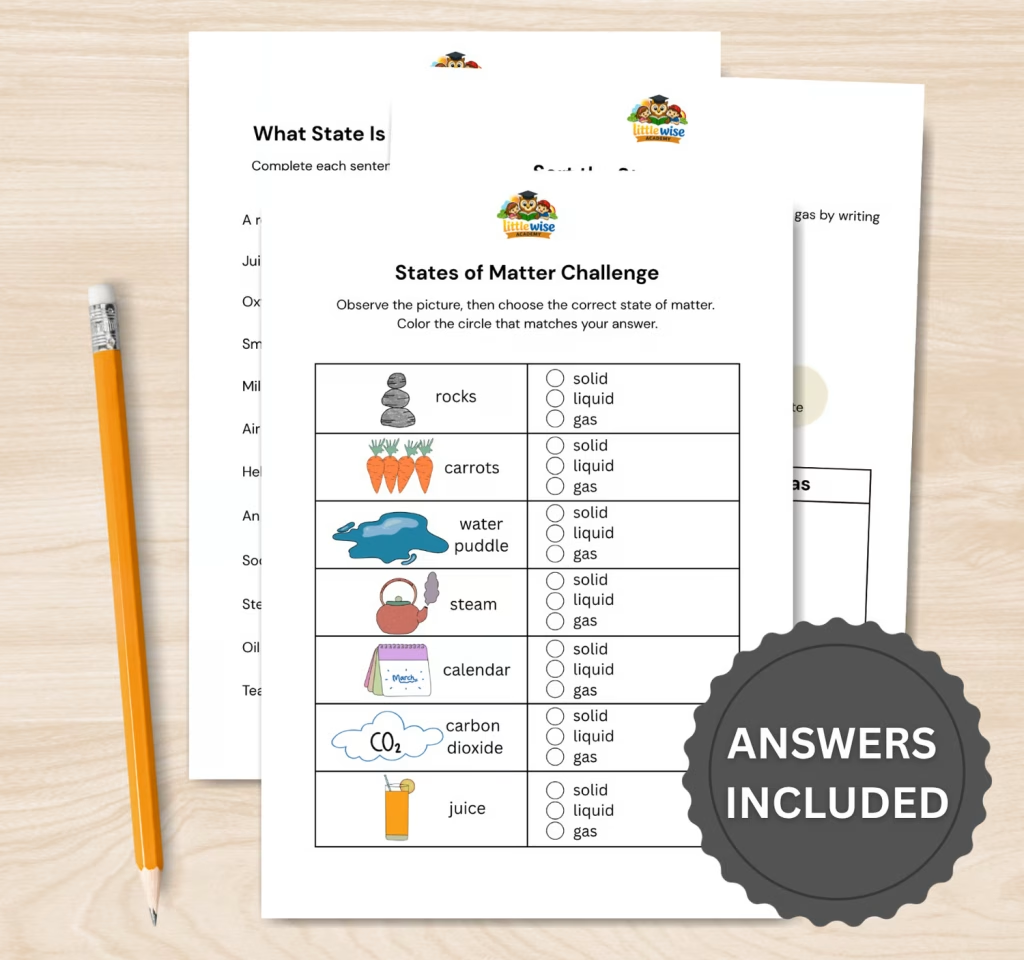
Want to give kids a little more practice after the lesson? Our 3-page State of Matter Worksheet gives students several ways to review what they’ve learned about solids, liquids, and gases. The worksheet includes different identification activities.
The next time your child picks up an ice cube, pours a glass of water, or blows up a balloon, remind them that they are interacting with matter. These familiar examples can help children understand the differences between solids, liquids, and gases.
A little observation, conversation, and hands-on learning can go a long way in helping kids build a strong foundation in science!
Curious about homeschooling? Learn how it works, its benefits and challenges, costs, and how to decide if learning at home is right for your family.
Help kids understand verbs with simple explanations and fun examples they’ll remember.

Want to help your child enjoy reading more? Try these easy ways to make story time more interactive, creative, and lovable.
Help kids master capitalization with the M.I.N.T.S. rule, and other essential capitalization rules.
Help your child master nouns with easy explanations of common, proper, concrete, abstract, and other types of nouns, plus everyday examples.