

Curious about homeschooling? Learn how it works, its benefits and challenges, costs, and how to decide if learning at home is right for your family.
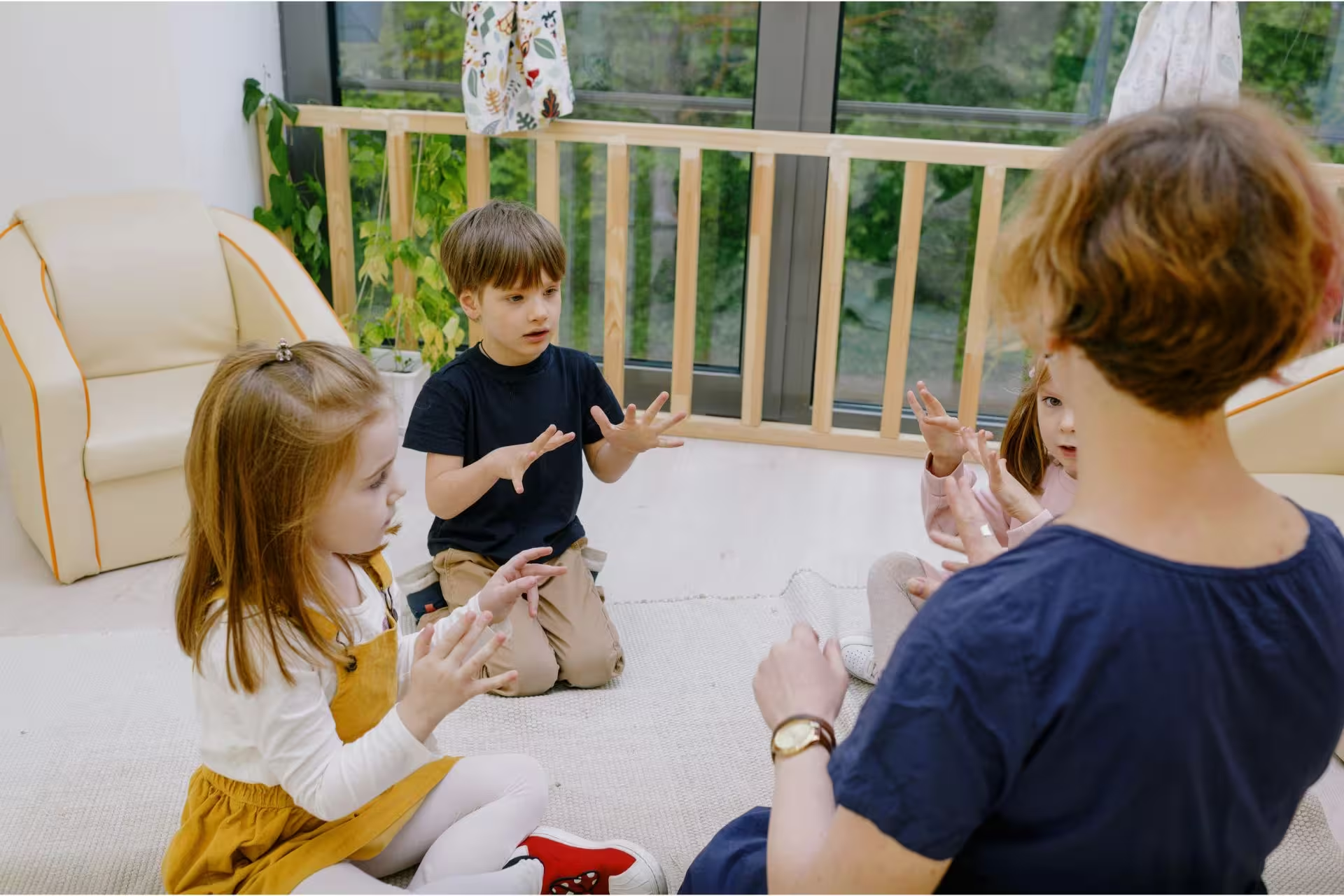
Imagine a group of third graders shopping at a pretend grocery store during math class. One child picks up a carton of milk for $3 and a loaf of bread for $2 and quickly announces, “That’s $5!” without reaching for a pencil or calculator.
Moments like these show the power of mental math, or the ability to solve math problems in your head. Helping kids develop this skill is one of the best ways to build a strong foundation for future math success.
In this article, we’ll explore what mental math is, its basic principles, and its incredible benefits. Finally, we’ll learn some strategies to help kids improve their mental math skills, so they can approach numbers with ease and enthusiasm.
Mental math is the ability to solve math problems in your head without using tools like paper, a calculator, or a pencil. It’s a quick and practical way to work with numbers, which helps kids build a strong foundation in math.
In K-5 classrooms, mental math might look like this:
These basic principles of mental math cover simple techniques that help kids solve math problems quickly in their heads. Here are some that are commonly used with students:
Kids learn to break numbers into smaller, easier parts. For example, to solve 23 + 15, they might break it into (20 + 10) + (3 + 5) = 38.
Recognizing number patterns like doubles (4 + 4 = 8) or making tens (7 + 3 = 10), helps kids solve problems faster.
This mental math trick helps kids understand the concept of multiplication by connecting it to something they already know — adding numbers repeatedly.
For example, 6 × 4 can be calculated as 4 + 4 + 4 + 4 + 4 + 4 = 24
Similarly, 5 × 2 is adding 2 five times: 2 + 2 + 2 + 2 + 2 = 10
Transform problems into questions that are easier to solve using inverse operations.
For instance, to solve x + 2 = 9, think of it as “What number plus 2 equals 9?” which leads to the inverse operation: 9 − 2 = 7
This is useful for addition, subtraction, or multiplication. For example, skip counting by 5s (5, 10, 15, 20…) makes solving problems like 4 × 5 easier.
When adding multiple numbers, you can simplify the calculation by grouping similar place values first. For example, in 27 + 38 + 43:
As children break the problem into smaller, more manageable parts, they can focus on one step at a time, which makes mental math easier and faster.
This can be considered a mental math trick, especially for younger children, as it simplifies calculations and builds number flexibility.
Here, they’ll understand that the order of addition (or multiplication) doesn’t affect the result, so kids can rearrange numbers in a way that makes solving problems easier.
For example: To solve 8 + 3, a child might reverse it to 3 8, which feels more natural to them if they are confident adding 8 to 3.
Similarly, 2 × 6 can be flipped to 6 × 2, which may be simpler to visualize as “two groups of six” or “six groups of two.”
Mental math helps children become more comfortable with numbers. Instead of relying on a calculator or writing everything down, they learn to recognize number patterns, estimate answers, and solve problems more easily.
Practicing mental math also gives kids a chance to strengthen their memory and attention. Solving problems in their heads means remembering numbers, thinking through each step, and staying focused until they find the answer. These skills can also support learning in other subjects.
Mental math also gives children a strong foundation for future math learning. When they understand how numbers work and relate to one another, it becomes easier to learn multiplication, division, fractions, decimals, and other more challenging math skills in the years ahead.
Getting better at mental math involves mastering the basics, practicing regularly, and making it fun. Let’s look at some advice below:
Before tackling more complex problems, ensure your child has a solid understanding of basic arithmetic — addition, subtraction, multiplication, and division. A strong grasp of these math concepts lays the foundation for mental math.
Like any skill, mental math improves with regular practice. Aim for 10–15 minutes a day, at least 4–5 days a week. Short, frequent practice sessions are often more effective than long ones. You can use worksheets, flashcards, math games, or quick verbal math challenges to keep practice fun.
Look for opportunities to practice throughout the day, too. Ask children to add up grocery prices, split snacks fairly, count coins, or figure out how much time is left before an activity.
Math games are fun and keep kids engaged while improving their skills. Board games, card games, or even apps focused on math can make learning feel like play!
For example, “Skip Counting” is a great mental math trick that can be practiced through games like “Skip Counting Bingo”. In this game, kids practice counting by 2s, 5s, 10s, and other numbers to mark off spaces on their bingo cards, which reinforces their skip counting skills.
Mental math is about understanding how numbers work. They encourage flexible thinking, improve confidence, and prepare kids for more advanced math concepts. With patience, practice, and fun activities, every child can continue improving their mental math skills.
Curious about homeschooling? Learn how it works, its benefits and challenges, costs, and how to decide if learning at home is right for your family.
Help kids understand verbs with simple explanations and fun examples they’ll remember.

Want to help your child enjoy reading more? Try these easy ways to make story time more interactive, creative, and lovable.
Help kids master capitalization with the M.I.N.T.S. rule, and other essential capitalization rules.
Help your child master nouns with easy explanations of common, proper, concrete, abstract, and other types of nouns, plus everyday examples.