
Curious about homeschooling? Learn how it works, its benefits and challenges, costs, and how to decide if learning at home is right for your family.
If your child is starting 5th grade, you may be wondering what they’ll learn in math this year. Fifth grade is a year of exciting growth. As students begin to bridge the gap between elementary and middle school, their skills are put to the test in new and challenging ways.
In fifth grade, students dive into a variety of math concepts that build on what they’ve learned in earlier grades. We’ll cover the key math concepts they’ll learn in 5th grade so you can help support their learning at home.
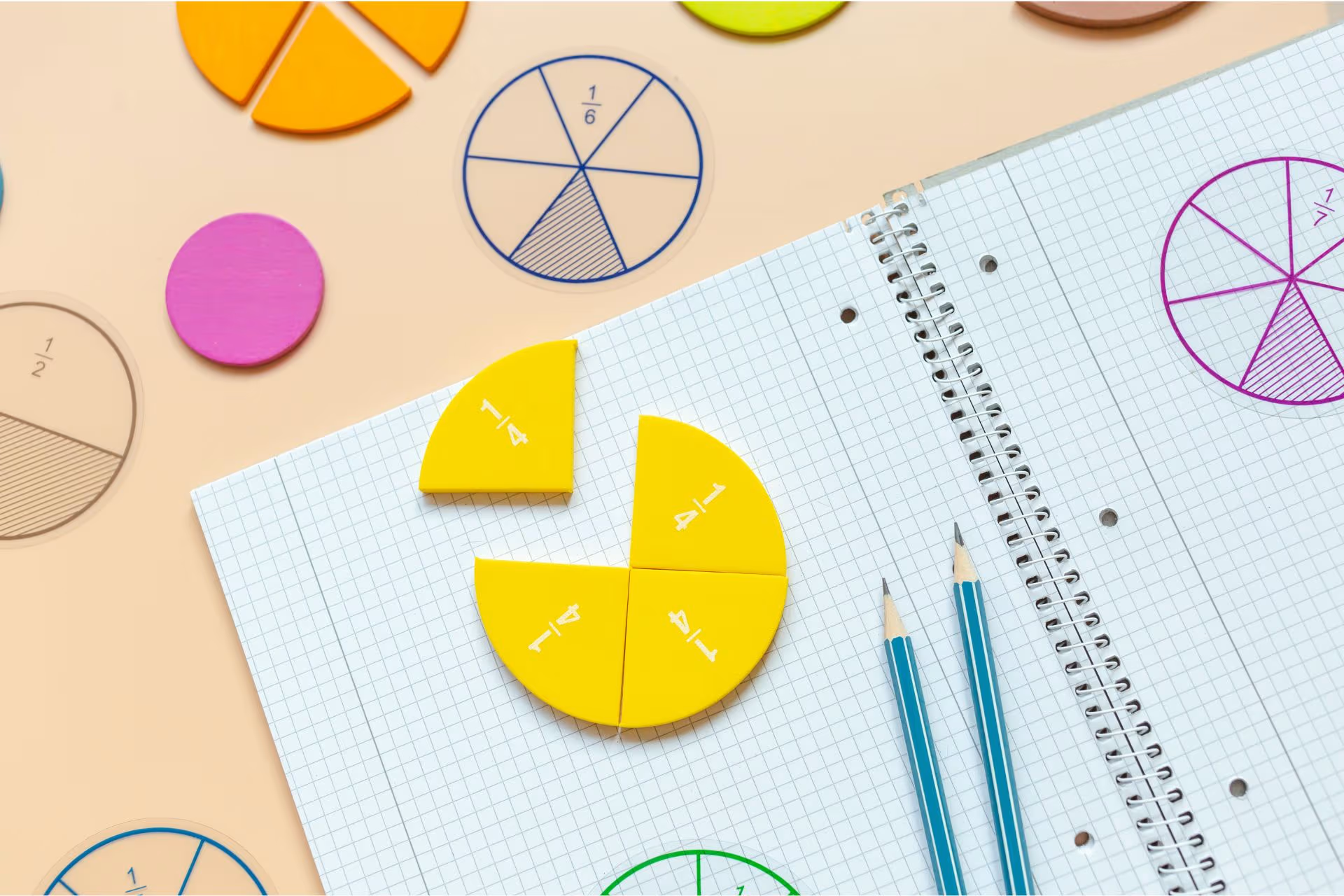
In 5th grade, students will learn that fractions represent parts of a whole and that different fractions can represent the same value. For example, 1/2 is equivalent to 2/4 because both represent the same amount.
They’ll also learn how to compare fractions with different denominators by finding a common denominator or converting them to decimals.
Students will practice comparing fractions using symbols like <, >, or = to figure out which fraction is bigger or smaller. This skill can help them with everyday tasks like sharing, cooking, or measuring.
This includes multiplying large numbers (like 36 x 45) and dividing numbers with two or more digits (like 128 ÷ 12). They also practice using strategies like long division and the standard algorithm for multiplication.
Students tackle real-world problems, such as calculating prices, measurements, or managing finances, and feel more prepared for advanced math in the future.
Related: When Do Kids Learn Multiplication and Division?
Students will focus on working with decimals, which are numbers that represent parts of a whole, similar to fractions. They’ll learn how to add, subtract, multiply, and divide decimals, and how to convert them to fractions and vice versa. For example, 0.5 is the same as ½.
Word problems are usually included when learning decimals in the classroom because they help students apply their skills in practical, real-life situations.
In 5th grade, students build on the graphing skills they learned in 4th grade by exploring the coordinate plane. They learn to plot points using ordered pairs (x, y) and identify locations across the four quadrants.
This is a natural progression from 4th grade, where students focus on interpreting and organizing data with graphs like bar graphs and line plots.
The coordinate plane introduces a more precise way of understanding relationships between numbers and spatial locations, which sets the stage for more advanced math concepts in later grades.
Volume is an important math concept for 5th graders. It helps students understand how to measure the amount of space inside 3D objects.
Exercises on volume in 5th grade often involve calculating the volume of a box using the formula length × width × height.
Students also work through word problems based on real-life scenarios, such as finding how much water an aquarium can hold, determining the capacity of a storage box, or calculating how many small cubes fit inside a rectangular prism.
Additionally, they compare the volumes of different objects to understand how size influences capacity.
Geometry helps students understand shapes and how they relate to one another. In 5th grade, they study two-dimensional shapes like triangles and rectangles, as well as three-dimensional shapes like cubes and spheres.
Students also learn about angles, symmetry, area, and perimeter. They often practice these skills by drawing shapes, building models, and solving hands-on puzzles, which makes geometry both engaging and fun.
Another lesson students learn is measuring and converting units within both the metric and customary systems. They practice converting inches to feet, cups to quarts, centimeters to meters, and grams to kilograms.
Students use these skills to solve word problems involving length, weight, liquid volume, and time. They also learn to choose the appropriate unit of measurement for different real-world situations. For instance, measuring the height of a tree or the amount of water in a container.
Solving numerical expressions means simplifying math problems that include numbers and operations like addition, subtraction, multiplication, and division. The process involves following a specific order to ensure accuracy.
For example, PEMDAS (Parentheses, Exponents, Multiplication/Division, Addition/Subtraction) helps students know which operation to perform first.
Powers of ten refer to numbers that are written as 10 raised to an exponent. The exponent shows how many times 10 is multiplied by itself. For example, 10² equals 10 × 10, or 100. Similarly, 10³ equals 10 × 10 × 10, or 1,000.
This concept is helpful for students when working with large or small numbers, as it simplifies writing them. For example, 5,000 can be written as 5 × 10³. Powers of ten are foundational for understanding exponents and scientific notation.
Understanding what your child is learning in 5th grade can make it easier to support them throughout the school year. Small moments of practice can improve the skills they’re building.
Help them stay consistent by making math a regular part of daily life instead of something they only do for homework. And if you ever want a quick reminder of their lessons, you can always come back to this guide for reference.
Curious about homeschooling? Learn how it works, its benefits and challenges, costs, and how to decide if learning at home is right for your family.
Help kids understand verbs with simple explanations and fun examples they’ll remember.

Want to help your child enjoy reading more? Try these easy ways to make story time more interactive, creative, and lovable.
Help kids master capitalization with the M.I.N.T.S. rule, and other essential capitalization rules.

Help your child master nouns with easy explanations of common, proper, concrete, abstract, and other types of nouns, plus everyday examples.